




Sirius’s Companion Star, Sirius B, Finally “Weighed”

"We're absolutely thrilled, after 143 years of frustration, to finally get the information we need about this star so that we can work out whether our theory of white dwarfs is actually correct."

- Martin Barstow, Ph.D., Leicester Univ., U.K.

Hubble Space Telescope Wide Field and Planetary Camera image of Sirius A, the brightest star in our nighttime sky, along with its faint, tiny sun companion, Sirius B, in lower left quadrant. Image credit: NASA, ESA, STScl, U. Leicester, U. Arizona.

December 17, 2005  Baltimore, Maryland - For the first time in human astronomical history, scientists have used NASA's Hubble Space Telescope to isolate the light from the white solar dwarf known as Sirius B orbiting its huge and bright companion, Sirius A, in the constellation Canis Major. Since the Sirius B discovery in 1862, astronomers have been frustrated by the intense glow of Sirius A overwhelming their ability to "see" and "weigh" tiny, but very dense, Sirius B.


Click here to subscribe and get instant access to read this report.

Click here to check your existing subscription status.

Existing members, login below:

MARSIS Radar Looking Below Surface of Mars

"It is very interesting that the signal penetrated quite easily through about  2 kilometers (1.2 miles) of material in the crater and that suggests to us that material is probably ice-rich."

- Jeffrey Plaut, Ph.D., JPL

MARSIS, Mars Advanced Radar for Subsurface and Ionosphere Sounding, has been looking below the Martian surface since June 2005 for water ice and/or liquid water. Composite image by European Space Agency.

December 16, 2005  Pasadena, California - Far from Earth is a mystery that scientists are trying to solve from an orbiting spacecraft that is now looking below the surface of Mars with deep ground-penetrating radar. It's called "MARSIS," which stands for Mars Advanced Radar for Subsurface and Ionosphere Sounding.


Click here to subscribe and get instant access to read this report.

Click here to check your existing subscription status.

Existing members, login below:

Updated – Unprecedented Eruption of Gas, Water and Mud Geysers Near Kingfisher, Oklahoma, Linked to Oil and Gas Exploration.

“We’ve got one spot out in the middle of a wheat field – it kind of looks like a geyser. It’s shooting anywhere from 7 to 10 feet in the air – water, mud and gas fumes. I’ve never seen anything like it. The Corporation Commission of Oklahoma has never seen anything like it.”

– John Crawford, Kingfisher, Oklahoma Fire Chief

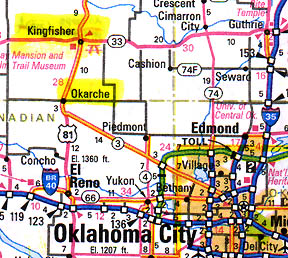
Kingfisher, population 4,500, and Okarche, population 2,000, are linked by the Winter Camp Creek (originally known as Dead Indian Creek). Between December 9 to 13, 2005, the gas and water eruptions had grown along 12 miles of the creek and tributaries to within 1 mile of Kingfisher and about 7 miles from Okarche.

December 15, 2005 Update – Today, more methane gas bubbling has spread south toward Okarche. Yesterday, four more gas eruptions in a wheat field were discovered about two miles from the city limits of Kingfisher, Oklahoma. The unprecedented – and so far, uncontrolled – eruptions of methane, water and mud on a 12-mile-long stretch of Winter Camp Creek and surrounding fields continues to frustrate authorities. Chesapeake Energy Corp., an independent oil and gas exploration company, was drilling on December 9, about eight miles from where the first gas and mud eruptions were reported in Section 2 of Kingfisher County. Today, Chesapeake said it would start flaring off some of the escaping gas and try to capture and sell more of it. What no one knows is whether this will reduce the underground pressure of the gas enough to slow down, or stop, the continuing gas eruptions that have occurred since the morning of December 9. Geologists are trying to figure out what has happened and what can be done to control the potentially explosive situation.Click for report.

Mystery of “Footprints” in 1.3 Million Year Old Mexico Volcanic Rock

"You're really left with two possibilities. One is that they are really old hominids - shockingly old - or they're not footprints."

- Paul Renne, Ph.D., UC-Berkeley

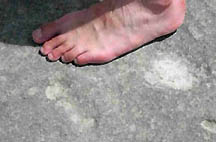
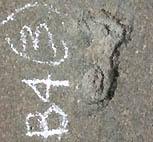
Left: Human left foot placed next to what appears to be left footprint in volcanic rock, Puebla, Mexico. Right: Possible right footprint, showing toe impressions and ball and heel, first discovered in 2003. Images courtesy John Moores University, U.K.
Above: Human left foot placed next to what appears to be left footprint in volcanic rock, Puebla, Mexico. Below: Possible right footprint, showing toe impressions and ball and heel, first discovered in 2003. Images courtesy John Moores University, U.K.

December 8, 2005  Berkeley, California - This past summer on the 4th of July at the British Royal Society Summer Exhibition Program, geologist Silvia Gonzalez, Ph.D., from Liverpool's John Moores University, announced that what appear to be human footprints in volcanic rock near Puebla, Mexico, were 40,000 years old. Puebla is about 1.5 hours by car southeast of Mexico City. The date was determined from Optically Stimulated Luminescence (OSL) of "some baked particles incorporated into the ash." Dr. Gonzales and her colleagues had first discovered the prints in 2003 and hypothesized that early hunters walked near a lake there across freshly deposited ash from volcanoes that are still active in the region. The ash mixed with rain and water which over time turned to rock. 

 

Click here to subscribe and get instant access to read this report.

Click here to check your existing subscription status.

Existing members, login below:

Zeta Reticuli I and II – Binary Home of Extraterrestrial Biological Entities?

"Betty described the (star) map as three-dimensional, like looking through a window. The stars were tinted and glowed. The map material was flat and thin (not a model), and there were no noticeable lenticular lines like one of our (human) three-dimensional processes. It sounds very much like a reflective hologram."

- Marjorie Fish, Amateur Astronomer, Astronomy, December 1974

Pages 4 -18 of the December 1974 Astronomy magazine featured an article entitled, "The Zeta Reticuli Incident" by astronomer and author, Terence Dickinson. Original magazine cover © 1974 Astronomy.

December 7, 2005   Thirty-one years ago the December 1974 issue of Astronomy magazine featured a 15-page article entitled, "The Zeta Reticuli Incident" by astronomer and author, Terence Dickinson. His article began:


Click here to subscribe and get instant access to read this report.

Click here to check your existing subscription status.

Existing members, login below:

Central Black Hole Affects Massive Perseus Galaxy Cluster

"The Perseus Galaxy cluster is a dramatic example of how a relatively tiny, but massive, black hole at the center of a galaxy can control the heating and cooling behavior of gas far beyond the confines of the galaxy."

- CXC

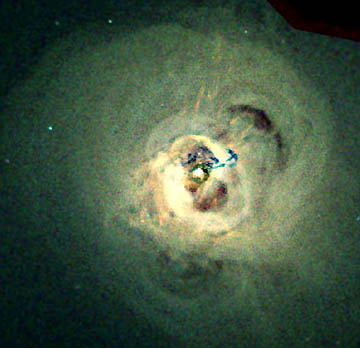
Massive Perseus galaxy cluster contains thousands of galaxies immersed in hot gas with massive black hole at center 250 million light years from Earth. Chandra X-ray Observatory image credit: NASA/CXC/IoA/A. Fabian et al.

December 4, 2005  Cambridge, Massachusetts - Chandra X-Ray Observatory in Cambridge, Massachusetts reports: "An accumulation of 270 hours of Chandra observations of the central regions of the Perseus galaxy cluster reveals evidence of the turmoil that has wracked the cluster for hundreds of millions of years. One of the most massive objects in the universe, the cluster contains thousands of galaxies immersed in a vast cloud of multimillion degree gas with the mass equivalent of trillions of suns.


Click here to subscribe and get instant access to read this report.

Click here to check your existing subscription status.

Existing members, login below:

Abduction by Grey ETs in Huge, Black Triangle 

"Time has no relevance to them. The taller being kept telling me that time was only important to me. Time could be whatever they wanted it to be. And that size was irrelevant to them."

- Bill Foster, Co-author, The Black Triangle Abduction

December 2, 2005  Kittery, Maine - One of the most important unauthorized leaks of alleged U. S. government information to investigators of the UFO/ET phenomena is a training manual produced by the American War Department in April 1954 and entitled: "Restricted SOM1-01 Majestic-12 Group Special Operations Manual: Extraterrestrial Entities and Technology, Recovery and Disposal, TOP SECRET/MAJIC EYES ONLY. In Chapter 2, Section 1, Paragraph 9, is the title: "Description of Craft." Four categories are detailed:

  • a) Elliptical or disc shape
  • b) Fuselage or cigar shape
  • c) Ovoid or circular shape
  • d) Airfoil or triangular shape


Click here to subscribe and get instant access to read this report.

Click here to check your existing subscription status.

Existing members, login below:

Former Canadian Minister of Defence Calls for Public Parliament Hearings About UFOs and ETs

“There have been visitors from space and they were as real as the airplanes flying overhead and they were designated by Gen. Nathan Twining (in 1947) as ‘enemy aliens.'”

– Paul Hellyer, Canadian Minister of Defence, 1963-1967

December 2, 2005  Toronto, Ontario, Canada – On July 4, 1997, I was in Roswell, New Mexico, at the 50th anniversary of the most famous UFO crash discovered by rancher, “Mac” Brazel, near Corona. U. S. military and intelligence units retrieved wreckage that was soon dismissed as a weather balloon. But joining that anniversary celebration was an Army man who declared the crash was definitely extraterrestrial and was not the only one the U. S. government had covered up. United States Army Lt. Col. Philip J. Corso had just released his groundbreaking book, The Day After Roswell.  Colonel Corso wrote astonishing details about U. S. government programs to retrieve extraterrestrial technology from downed craft and to back engineer and patent it inside American corporations. On the Colonel’s list of extraterrestrial technologies were:Click for report.

H5N1 Avian Flu Has Infected 21st Person in Thailand. 13 Have Died.   

“The H5N1 avian flu virus has mutated into a more dangerous form that could breed more effectively in mammals.”

– Cao Bao Van, Dir.,
Molecule Biology Department, Pasteur Institute, Vietnam

Early 1997 strain of H5N1 avian influenza virus shows golden-brown in this electron micrograph. Virus in 2005 has mutated to more virulence in lab tests. Image 1997 by CDC.

November 13, 2005  Washington, D. C. – The Centers for Disease Control and World Health Organization confirm that the 21st person has been infected with H5N1 bird flu in Thailand. The victim is an 18-month-old boy now in a Bangkok hospital. Medical authorities think the child contracted the deadly virus from three fighting cocks and a chicken kept at the family’s home in Bangkok. All those birds died soon after the child was hospitalized. So far, twenty-one people in Thailand have been infected by the H5N1 bird flu and 13 have died.

Click for report.

Is the Sun Heating Up?   

"The Sun right now is probably averaging over several decades the most active it's been in 400 years."

- Sallie Baliunas, Ph.D., Harvard Smithsonian Center for Astrophysics

The large white spot on the face of the sun is called "Sunspot 822." Its current length on November 17, 2005, is 87,000 miles (140,000 km), about the size of Jupiter. According to SpaceWeather.com, "This sunspot poses a threat for M-class solar flares. NOAA forecasters estimate a 50% chance of one during the next 24 hours. Eruptions in the days ahead could cause magnetic storms on Earth." November 17, 2005, solar image by Solar and Heliospheric Observatory (SOHO).

November 18, 2005  Cambridge, Massachusetts - Astrophysicists are scratching their heads about what's happening on the sun and in our solar system. Why has this so-called "Solar Minimum" been so active? It should be quiet now with very few sunspots because this is supposed to be the low point of the Sun's 11-year-sunspot cycle. But this week, there was a sunspot called 822 that's 87,000 miles across - the size of the planet Jupiter! Could it erupt with more powerful X-flares as has happened the past few months. Big flares threaten all the broadcast, global positioning and military satellites that now orbit our planet. As I've reported before in Earthfiles, the sun is not "normal." Is it warming up? Earth's North Pole and Mars's South Pole are melting at a surprisingly rapid rate. Even far out Pluto seems to show some melting. Is the sun a bigger player in all this than originally thought? 


Click here to subscribe and get instant access to read this report.

Click here to check your existing subscription status.

Existing members, login below: