






Click here to subscribe and get instant access to read this report.
Click here to check your existing subscription status.
Existing members, login below:

“…I am certain that there is some other form of intelligence, either on this planet or visiting the crops from somewhere else. I have no doubt about that after seeing what I saw.”
– Mike Booth, Marlborough, U. K. Resident

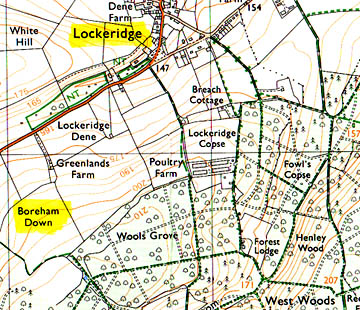
July 1, 2005 Lockeridge, Wiltshire, England – Mike Booth has spent much of his forty-five years designing for race cars and planes. He received his British National Diploma in Art from Buckinghamshire’s Amersham School of Art and Design in 1979. In his spare time, he also writes songs and tries every other night to ride his mountain bike from his home near Marlborough out the road from Lockeridge, past Boreham Down and the West Woods on to Alton Barnes. The road goes right through the heart of Wiltshire’s crop circle country, but Mike had never seen anything especially unusual until 6:30 p.m. on Tuesday, June 21, 2005, as he was riding next to Boreham Down.Click for report.

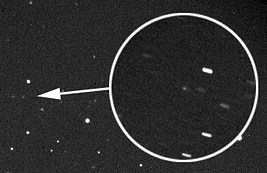
June 28, 2005 Papros in Central Poland – Report from Independent Research Group Torun (IRG Torun), based northeast of Inowroclaw: Click for report.

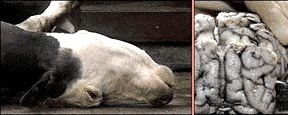
June 27, 2005 Washington, D. C. – The U. S. Department of Agriculture confirmed on June 25, 2005, that the second U. S. cow in 18 months has tested positive for bovine spongiform encephalopathy, or BSE, also known as Mad Cow disease. The first case of Mad Cow found in the U.S. was in December 2003 in a Washington state dairy cow that had been imported from Canada.This 2005 infected cow was at least 8 years-old and rumors in the cattle industry are that the animal was born and raised in Texas. If so, this would be the first confirmation that the always fatal BSE prion disease that destroys brains and nervous systems is in some American cattle and not solely linked to imported animals, as once previously thought.
“This event in the vertebrates that created the ultra conserved elements in the birth of the vertebrate lineages was a unique event. …It cannot be a coincidence that there have been so few changes in these (vertebrate 481 ‘junk DNA’) elements over this enormous span of half a billion years. It’s got to be that they are functionally important.”
– David Haussler, Ph.D., UC-Santa Cruz
June 25, 2005 Santa Cruz, California – A biomolecular engineer at the University of California in Santa Cruz was published in a recent Science journal stating his lab has found 481 genetic sequences that are the same in all vertebrates from humans to rats and are so important they have not changed in nearly half a billion years. But until now, those genes were considered “junk DNA.”Click for report.