

Vietnamese Doctor Studying H5N1 Bird Flu Falls Victim to Virus

June 21, 2005   Hanoi, Vietnam - This week the Tuoi Tre (Youth) newspaper in Hanoi reported that a medical doctor who has been taking samples from people diagnosed with the dangerous H5N1 virus, or bird flu, is now sick with the virus himself. The male doctor is in the hospital and his condition is reported as "stable." Since the H5N1 virus jumped from animals to humans in late 2003, thirty-eight Vietnamese patients have died. 


Click here to subscribe and get instant access to read this report.

Click here to check your existing subscription status.

Existing members, login below:

CDC Reports First 2005 Human Case of West Nile Virus in Kansas

"In a CDC study to be published next month in July 2005, an estimated 10% of Americans who develop the most severe form of West Nile disease will have polio-like paralysis. Many patients are in their 30s to 50s. The growing paralysis problems are of great concern, as well as the death toll. Since 1999, CDC has counted more than 16,600 human cases and 654 deaths." - 060205 Earthfiles

Top: Photomicrograph of West Nile Fever Virus. Bottom: Photograph of Culex pipiens female mosquito, carrier of West Nile Fever Virus, courtesy Entomology Image Gallery.

     
June 21, 2005   Atlanta, Georgia - The Centers for Disease Control issued the following press release this week:


Click here to subscribe and get instant access to read this report.

Click here to check your existing subscription status.

Existing members, login below:

West Nile and Bird Flu: Two Increasingly Dangerous Viruses

"I can't imagine anything more catastrophic effecting the human race today than a pandemic of H5N1 influenza around the world. ...Anywhere from 180 to 360 million people could die from this particular strain of virus."

- Michael T. Osterholm, Ph.D., University of Minnesota

June 2, 2005   Minneapolis, Minnesota - 

West Nile Fever Virus

Left: Photomicrograph of West Nile Fever Virus. Right: Photograph of Culex pipiens female mosquito, carrier of West Nile Fever Virus, courtesy Entomology Image Gallery.

     
Dr. Henry Masur at the National Institutes of Health (NIH) in Washington, D. C., told Associated Press this week that the West Nile Fever Virus working its way through the United States is more virulent than its viral cousin in Europe, Asia and Africa and "has caused more cases of paralysis than there were in many years of polio." By 2005, it has spread to nearly every state. 


Click here to subscribe and get instant access to read this report.

Click here to check your existing subscription status.

Existing members, login below:

USAF Wants Space Weapons Program

Hundreds of commercial, military, and research satellites now orbit relatively close by, in low-Earth orbit. Others lie in safer geosynchronous orbit, visible here as the ring of dots circling farthest from the Earth. Illustration © 2005 by IEEE.


May 19, 2005  Washington, D. C. - A year ago in June 2004, I reported about German physicist Werner Von Braun's warning before he died in 1977 that space above planet Earth and beyond should not be used for weapons and war. Dr. Von Braun, who had worked in America's early rocket program at White Sands Missile Range in New Mexico, told a woman named Carol Rosin who worked for him shortly before his death, "that we must prevent the weaponization of space from happening because it will end up destroying humanity." Dr. Von Braun also told Carol Rosin that he knew there was other life in the universe and we would jeopardize contact with them if we persisted with weaponizing space.


Click here to subscribe and get instant access to read this report.

Click here to check your existing subscription status.

Existing members, login below:

Did Milky Way Gas and Dust Turn Earth Into Icy Snowball Four Times?

Sharpest image of the Whirlpool Galaxy ever taken was made by NASA's Hubble Space Telescope in January 2005. The pink arms are "star-formation factories, compressing hydrogen gas and creating clusters of new stars." Each arm of stars moves forward through changing densities of gas and dust, as our solar system moves with its Sun in the rotating arms of our Milky Way Galaxy. Image credit: NASA, ESA, and Hubble Heritage Team.

May 7, 2005  Boulder, Colorado - In the Earth's 4.5 billion year history so far, there have been five major extinction events, plus the current sixth caused by the expansion of human civilization into animal and plant habitats and subsequent impact on global warming. The five previous major extinction events were based on the most complete study ever done of all the known world marine fossils. That was the life work of University of Chicago paleontologist, John (Jack) J. Sepkoski, Ph.D. He documented 36,380 genera of marine life over the past half a billion years. After his death, his work was published as Compendium of Fossil Marine Animal Genera and is the most complete reference available for the study of biodiversity and extinctions. [See 040105 Earthfiles.]


Click here to subscribe and get instant access to read this report.

Click here to check your existing subscription status.

Existing members, login below:

What Are The Straight Lines on Saturn’s Titan Moon?

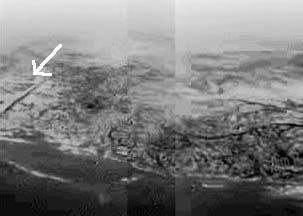
Dark "channels," perhaps draining down into dark "methane sea" at bottom, in image taken from about 8 kilometers altitude by Huygens probe with a resolution of about 20 meters per pixel. Boundary between high, lighter-colored terrain and and darker lowland area on Titan resembles a coast line. One of the many mysteries: what is the right angle structure beneath the white arrow? This composite was produced from images returned January 14, 2005, by ESA's Huygens probe. Image source: ESA/NASA/JPL/University of Arizona.


May 6, 2005  Tucson, Arizona - This week planetary scientists at the University of Arizona in Tucson submitted their first paper about the Cassini/Huygens probe images of Saturn's huge moon, Titan, to the British journal, Nature. But the article, with many images and hypotheses about what the surface geology might be on the mysterious moon, won't be released until the end of 2005. One of the many surface features that have provoked scientists to wonder what they are seeing is what appears to be a straight-sided 90-degree angle at the left of a composite image released on January 14, 2005, soon after the Huygens probe had descended from the Cassini spacecraft to land on Titan. This week I asked one of the team members studying Titan's surface images to comment on the "structure."


Click here to subscribe and get instant access to read this report.

Click here to check your existing subscription status.

Existing members, login below:
Outer Space Impact At Serpent Mound, Ohio, 256 Million Years Ago

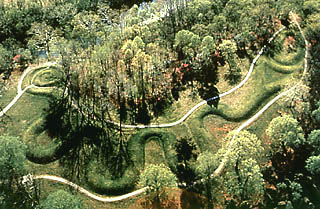
April 20, 2005  Dayton, Ohio - Around 11 a.m. Sunday, August 24, 2003, at the Brush Creek bridge in Peebles, Ohio, a family saw "an oddity in a nearby soybean field that was not natural." It turned out to be an extraordinary crop formation in soybeans only a half mile from the tail of the famous Serpent Mound mysteriously built a thousand years ago to be seen from the sky, but no one knows why.

Photograph of ancient Serpent Mound near Locust Grove and Peebles, Ohio. Mound is 800 meters long (.5 miles) and its construction is placed around 800 A.D. Soybean formation was 3,000 feet ( a little more than a half mile) to the east of the serpent's tail shown at left of photo. Image courtesy Wright State University.


Click here to subscribe and get instant access to read this report.

Click here to check your existing subscription status.

Existing members, login below:
What’s Killing Off Marine Life Every 62 Million Years?

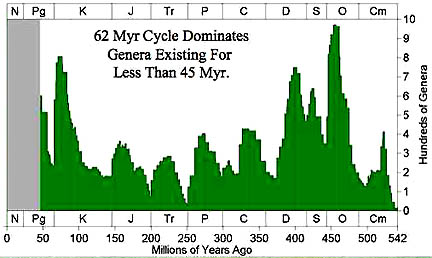
Graph of Earth life genera (genus of species) declining on a cycle of every 62 million years for the past half billion years. Graphic © 2005 by Richard Muller, Ph.D.

Apri1 1, 2005  Berkeley, California - Whatever humans do, or don't do, in this century to help sustain the Earth's ecosystem, it appears that our planet has endured some kind of assault every 62 million years which kills marine life all over the world. The last big global catastrophe is definitely linked to the impact of a large asteroid near the Yucatan Peninsula in the Gulf of Mexico 65 million years ago. About 75% of all living creatures in the oceans and on land were literally wiped out to extinction, including the dinosaurs. Could there be a 62-million-year cycle of asteroids, comets or other cosmic debris that affects our solar system and Earth? Or is it fluctuations in our Sun? Or the periodic volcanic violence of our own planet? Or something else?


Click here to subscribe and get instant access to read this report.

Click here to check your existing subscription status.

Existing members, login below:
Soft Tissue – Even Blood Cells? – Found in Tyrannosaurus rex Leg Bone

Two Tyrannosaurus rex dinosaurs below a Pteranod flying on bat-like membranes. Painting © by Mark Hallet in Dinosaur Illustrations.

April 1, 2005  Raleigh, North Carolina - One of the most awesome creatures that ever walked on Earth was the 20-foot-tall Tyrannosaurus rex, or T-rex. It was a big meat eater with many sharp teeth as long as six inches in a head that could be five feet long. Sixty-five million years ago, the big dinosaurs were roaming what is now called the Hell Creek Formation in the state of Montana when an asteroid, maybe 6 miles in diameter, hit the Earth near the Yucatan Peninsula. That violent impact and its subsequent fires and dust blocked sunlight around the world for months and killed off more than 75% of all Earth life. Thirty-one dinosaur skeletons have been found at the Hell Creek Formation in the past four years by Montana State University paleontologist, Jack Horner. And one of those is the first dinosaur remains to have stretchy tissue and even what appears to be blood cells inside one of its leg bones. This astonishing discovery recently published in the March 2005 journal, Science, was made by biologist and paleontologist, Mary Higby Schweitzer, Ph.D., at North Carolina State University's Dept. of Marine Earth and Atmospheric Sciences.


Click here to subscribe and get instant access to read this report.

Click here to check your existing subscription status.

Existing members, login below:

Spirit Rover Finds Magnesium Sulfate Near “Larry’s Lookout” in Columbia Hills on Mars.

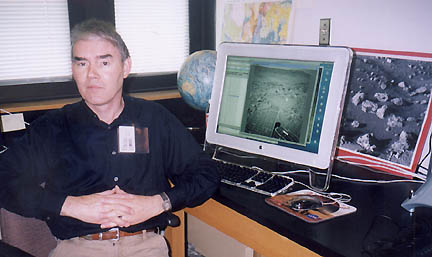
March 26, 2005   Albuquerque, New Mexico - Earthfiles is staying in touch with Larry Crumpler, Ph. D., Mars Spirit Rover Mission and Research Curator, who receives data from Spirit and designs maps based on rover data. Dr. Crumpler is based in the Volcanology and Space Science Department at the New Mexico Museum of Natural History and Science in Albuquerque, New Mexico. He is the scientist after whom "Larry's Lookout" was named in the Gusev Crater's Columbia Hills.

This week he emailed me twice about Spirit's long trek across the Columbia Hills and included the stunning image of Martian soil rich in magnesium sulfate. No question that Mars was wetter when the Columbia Hills rocks were deposited before the Martian climate suddenly changed very early in the red planet's history to greater dryness. See more information in Earthfiles 022505. 

Larry Crumpler, Ph.D., Planetary Scientist and member of NASA Mars Spirit Rover team. Dr. Crumpler is also Research Curator for Volcanology and Space Science at the New Mexico Museum of Natural History and Science in Albuquerque, New Mexico. Photograph © 2005 by Linda Moulton Howe.


Click here to subscribe and get instant access to read this report.

Click here to check your existing subscription status.

Existing members, login below:
EARTHFILES