Evidence of 7000 Year Old Flood and Human Habitation Discovered Beneath Black Sea

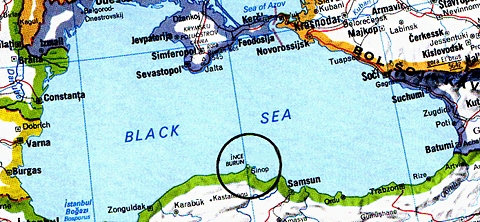
Black ring indicates Sinop, Turkey and the area twelve miles north where marine geologist, Robert Ballard and his research team discovered "remains of an ancient structure that was apparently flooded in a deluge of biblical proportions."

September 17, 2000  Sinop, Turkey - This week a discovery twelve miles off the northern coast of Turkey near the town of Sinop (SIN-op) was announced that could force archaeologists and anthropologists to rewrite history about the relationship of Neolithic cultures in Europe, Asia and Mesopotamia seven thousand years ago.


Click here to subscribe and get instant access to read this report.

Click here to check your existing subscription status.

Existing members, login below:

Black Holes – A Surprising Mass in the M82 Galaxy

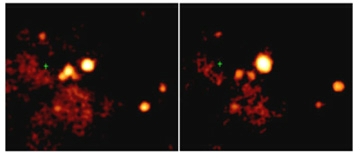
Bright, near-white, oval X-ray image at center of frame on right is recent of the central region of a galaxy called M82 compared to image on left taken in June 2000. The anomalous V-shaped brightening in the left frame is a transitory intensity of x-rays that are unidentified but typical of x-ray fluctuations. Chandra X-ray Observatory images courtesy of NASA/SAO/CXC.

September 12, 2000 Washington, D. C. - Today at NASA headquarters in the nation's capitol, astrophysicists presented new x-ray images by the Chandra X-ray Observatory that indicate something with the mass of at least 500 of our suns is packed into a region about the size of our moon in a nearby galaxy called M82. Such concentrated mass is probably a black hole. And if so, it is the first discovery of such a large black hole outside galactic centers. Until now, scientists have found evidence of small black holes only ten to twenty times bigger than our sun (one solar mass) or massive ones millions of times more massive than our sun, but only at the center of galaxies. This new discovery is at least 600 light years from the center of M82 and could be a new type of black hole that evolves and grows from the merger of many black holes. Further, the scientists reported that the intensity of the X-rays was rising and falling every 600 seconds, a ten minute cycle. Cycles are more consistent with matter falling into a black hole than the collapse of one gigantic star.


Click here to subscribe and get instant access to read this report.

Click here to check your existing subscription status.

Existing members, login below:

Arctic Ice Melt Threatens Polar Bears

"If the prediction of total Arctic ice melt by 2030 is correct, then it is truly frightening because I think it would result in huge ecological changes to the polar oceans, the loss of species, changes of balance. The effects on climate change around the Northern Hemisphere particularly could be quite dramatic."

- Ian Sterling, Ph.D., Zoologist and Research Scientist

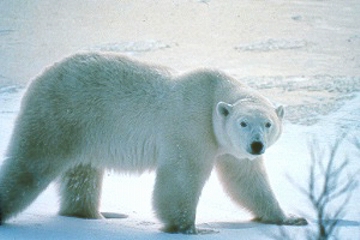
 Polar bear near Churchill, Manitoba, Canada on the western edge of Hudson Bay. Photograph © 2000 by Travel Manitoba.
Polar bear near Churchill, Manitoba, Canada on the western edge of Hudson Bay. Photograph © 2000 by Travel Manitoba.

September 10, 2000  Churchill, Manitoba, Canada - The Arctic and northern latitudes have been singled out by the World Widelife Fund as the most vulnerable to the rapid rate of global warming. Their sobering statistic is that 20 percent of all species in northern environments could die out as melting ice and tundra completely change the habitats.


Click here to subscribe and get instant access to read this report.

Click here to check your existing subscription status.

Existing members, login below:

Hubble Photographs Mystery Object in Centaurus Constellation

"I have used the Hubble quite extensively to look at many dying stars and we've seen many mysterious and beautiful shapes and structures, but we've never seen such a jet-like structure."

- Raghvendra Sahai, Ph.D., Astrophysicist, Jet Propulsion Lab

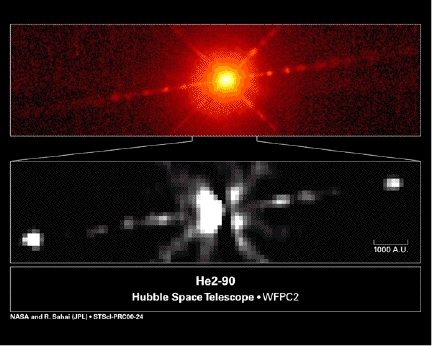
In the top Hubble photo, the longest, nearly horizontal, jets of hot gas pulse outward from both sides of a mysterious object called He2-90. (The x-shaped streaks are reflections in the telescope). In the bottom Hubble photo, enhancement of the mysterious bright object is bisected by a large, vertical disk of gas and dust. Photographs in August 2000 courtesy NASA.

September 6, 2000  Pasadena, California - At the Jet Propulsion Laboratory in Pasadena, astrophysicists are puzzled by a bright object about 8,000 light years from earth in the constellation Centaurus. It is giving off large jet pulses that are more typical of star births. But there is also an accretion disk of gas and dust often associated with a dying star. The paradox of birth and death characteristics is forcing a re-evaluation of what has been considered a planetary nebula since the 1990s.


Click here to subscribe and get instant access to read this report.

Click here to check your existing subscription status.

Existing members, login below:

Pulsing, Jumping Light in West Stowell, England Field

August 26, 2000 East Field, Wiltshire, England – On Monday, July 31st late in the evening, crop circle researchers Ed and Kris Sherwood were in an East Kennett crop formation when a bright yellow unidentified aerial object appeared followed immediately by a loud, military-type helicopter that nearly ran them down in the field. After the couple went to the ground to escape the low-flying helicopter, it pursued the bright yellow object again, both disappearing behind a hill. Then a second bright yellow aerial object appeared. The Sherwoods videotaped the helicopter and yellow object and learned that other people did, too. Frank Laumen, a researcher and photographer from Germany, was at the bridge in Allington and could see lights and a helicopter back toward East Kennett. He videotaped the interactions. Andy Buckley from Manchester, England was also on Martinsell Hill and videotaped helicopter and light activity about the same time.Click for report.

250 Photographs of Mars Show Signs of Water

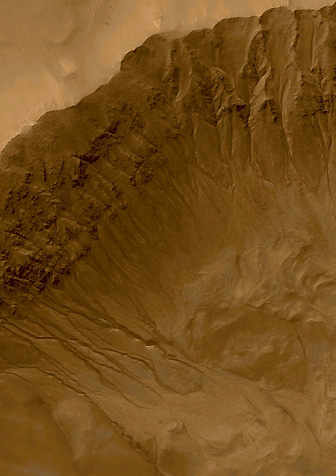
Gorgonum Crater on Mars showing dozens of possible water trails in the red planet crater wall. Photograph courtesy of NASA and Jet Propulsion Lab from Mars Global Surveyor.

June 26, 2000  Boulder, Colorado - Major breaking news this past week was NASA's press conference in Washington, D. C. at NASA Headquarters on Thursday, June 22nd, to announce 250 photographs of widespread areas on Mars that closely resemble gullies and springs of water on earth.


Click here to subscribe and get instant access to read this report.

Click here to check your existing subscription status.

Existing members, login below:

A Dinosaur with A Warm-Blooded Heart

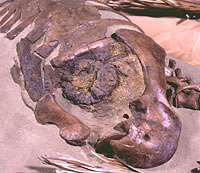
The fossilized chest cavity of a plant-eating Thescelosaurus dinosaur that died 66 million years ago. The circular, dark object at the center is the dinosaur's heart now confirmed to be four chambered with one aorta like warm-blooded animals today, not the cold-blooded reptilian metabolism assumed for dinosaurs over the past 150 years. Photograph © 2000 by Paul Fisher, NCSU College of Veterinary Medicine Biomedical Imaging Resource Facility, Raleigh, North Carolina.

April 30, 2000 Raleigh, North Carolina - There was an astonishing discovery in the Hell's Creek sandstone of northwestern South Dakota back in 1993: a 13 foot long dinosaur with a heart in its rib cage. It's all fossilized, of course, but now modern CT scanning technology has confirmed it's four chambered with one aorta like warm-blooded animals today, not the cold-blooded reptilian metabolism assumed for dinosaurs over the past 150 years.


Click here to subscribe and get instant access to read this report.

Click here to check your existing subscription status.

Existing members, login below:

A Black Hole in the Big Dipper?

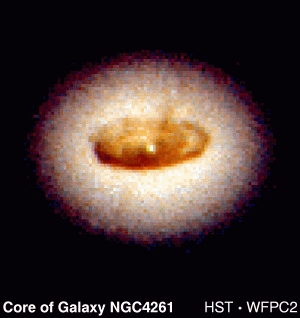
An example of a likely black hole. This is a 1997 Hubble Space Telescope image of a suspected black hole at the center of galaxy NGC4261. Inside the white galactic core, there is a brown spiral-shaped disk. The dark object is about as large as our solar system, but weighs 1,200,000,000 times as much as our sun. That means the dark object's gravity is about one million times as strong as the sun. "Almost certainly this object is a black hole," reported Britain's Cambridge University. Photograph courtesy of Hubble Space Telescope.

April 24, 2000 MIT, Cambridge, Massachusetts ­ Ten years ago on April 24, 1990 the Hubble Space Telescope was launched with its imperfect mirror. Later astronauts repaired it. Since then, Hubble has provided some of the most astounding photographs of the universe over the past decade. And recently, Hubble and the Chandra X-Ray telescopes were focused on a spot in the Big Dipper about 6,000 light years from earth to help solve a mystery.


Click here to subscribe and get instant access to read this report.

Click here to check your existing subscription status.

Existing members, login below:

Secret Radar Stations in New Mexico, Part 1

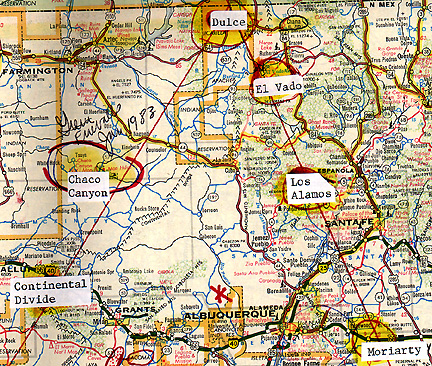
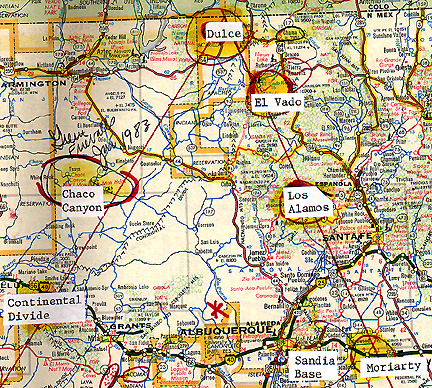
A triangle of sensitive geographic areas and three secret experimental microwave radar stations. Construction begun in late 1947 of El Vado (AFS-P8), Moriarty (AFS-P7), and Continental Divide (AFS-P51). The three radar stations were part of the U. S. Aircraft Control and Warning (AC&W) system that also became known as LASHUP. One of El Vado's specific missions was to protect the Los Alamos Laboratory and the Atomic Energy Commission's atomic bomb production at Los Alamos and Sandia Base.

April 2, 2000  Santa Fe, New Mexico - The New Mexico legislature is in session and in February 2000 State Representative J. Andrew Kissner (Las Cruces, Dona Ana County) was successful in having a once-secret experimental microwave radar station at El Vado in Rio Arriba County north of Los Alamos added to the New Mexico State Historical Register. The importance of the El Vado radar site is underscored by the fact that its construction was specifically authorized by President Harry S. Truman himself.


Click here to subscribe and get instant access to read this report.

Click here to check your existing subscription status.

Existing members, login below:

Secret Radar Stations in New Mexico, Part 2

 A triangle of sensitive geographic areas and three secret experimental microwave radar stations. Construction begun in late 1947 of El Vado (AFS-P8), Moriarty (AFS-P7), and Continental Divide (AFS-P51). The three radar stations were part of the U. S. Aircraft Control and Warning (AC&W) system that also became known as LASHUP. One of El Vado's specific missions was to protect the Los Alamos Laboratory and the Atomic Energy Commission's atomic bomb production at Los Alamos and Sandia Base.
A triangle of sensitive geographic areas and three secret experimental microwave radar stations. Construction begun in late 1947 of El Vado (AFS-P8), Moriarty (AFS-P7), and Continental Divide (AFS-P51). The three radar stations were part of the U. S. Aircraft Control and Warning (AC&W) system that also became known as LASHUP. One of El Vado's specific missions was to protect the Los Alamos Laboratory and the Atomic Energy Commission's atomic bomb production at Los Alamos and Sandia Base.


Click here to subscribe and get instant access to read this report.

Click here to check your existing subscription status.

Existing members, login below:

EARTHFILES